
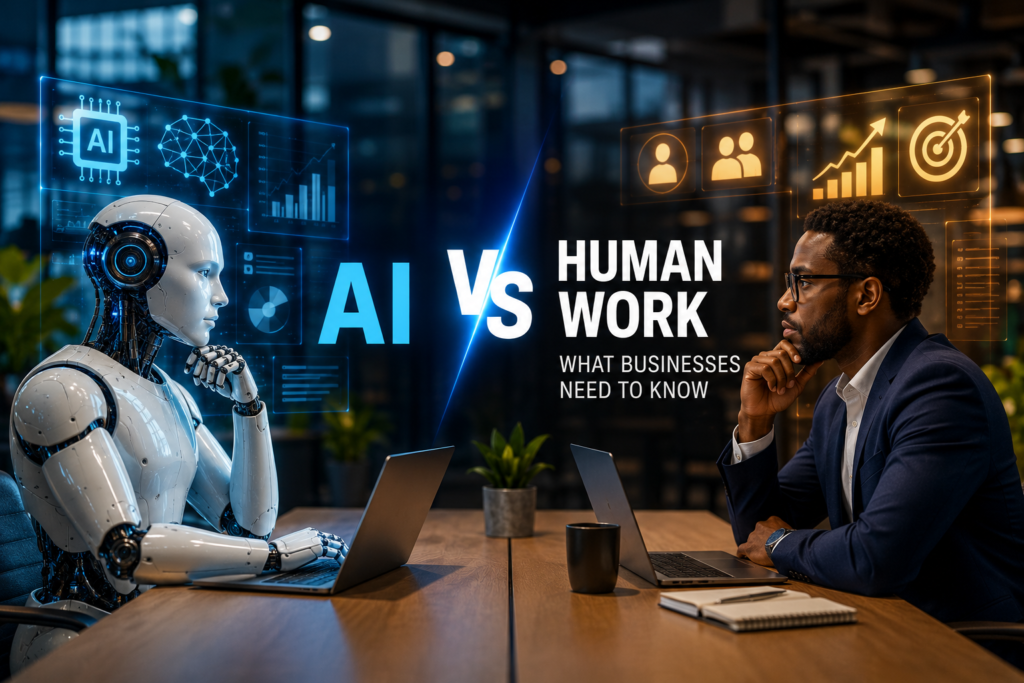
AI vs Human Work
The conversation surrounding Artificial Intelligence and human employment has become one of the most important business discussions in the modern world. Across industries globally, businesses are increasingly integrating AI-powered systems into their operations, automating tasks that were previously handled entirely by human workers. This transformation is changing how companies operate, how employees work, how customers interact with businesses, and how entrepreneurs make strategic decisions.
In 2026, the relationship between AI and human work is no longer a theoretical debate reserved for technology conferences and research laboratories. It has become a practical business reality affecting startups, SMEs, multinational corporations, creators, professionals, investors, and governments worldwide. Business owners are now asking serious questions about automation, productivity, workforce efficiency, operational costs, and the future role of employees in an increasingly AI-driven economy.
Artificial Intelligence has moved rapidly from being an emerging technology to becoming a core business infrastructure across industries such as finance, healthcare, education, real estate, customer service, logistics, legal services, manufacturing, media, marketing, and e-commerce. Businesses are now using AI systems for customer support, data analysis, workflow automation, content creation, marketing optimization, fraud detection, predictive analytics, inventory management, administrative operations, and business intelligence.
At the same time, many workers fear that AI may eventually replace human jobs completely. Employees are increasingly concerned about automation, job security, workforce restructuring, and the future of AI and human employment in a technologically evolving marketplace. Business leaders also face difficult questions about balancing operational efficiency with ethical workforce management.
However, the reality is far more complex than the simplistic narrative that “AI will replace humans.” In practice, Artificial Intelligence and human work are becoming increasingly interconnected rather than mutually exclusive. Most businesses are discovering that AI performs best when combined with human intelligence, creativity, emotional understanding, ethical judgment, leadership, and strategic thinking.
One of the major misunderstandings surrounding AI adoption is the belief that technology alone automatically creates business success. In reality, businesses that integrate AI successfully are usually those that understand how to combine intelligent automation with skilled human contribution. Technology may improve efficiency, but businesses still rely heavily on trust, communication, negotiation, leadership, innovation, emotional intelligence, and customer relationships.
For startups and entrepreneurs, the conversation around AI vs human work is especially important because many growing businesses are trying to reduce costs while improving productivity. Startups frequently operate with limited budgets, small teams, and increasing customer demands. AI tools offer significant opportunities for automation and operational efficiency. However, businesses must also understand where human expertise remains irreplaceable.
In Nigeria and across emerging economies, many businesses are still at the early stages of AI adoption. Some organizations fear automation completely, while others attempt to automate too aggressively without understanding operational realities, workforce implications, or compliance considerations. Both extremes create problems.
The business landscape in 2026 requires a balanced understanding of how AI works, what AI can realistically achieve, what limitations still exist, why human workers are still important in business, and how organizations can strategically combine both for sustainable growth.
Sundar Pichai, CEO of Google, once stated:
“AI is one of the most profound things we’re working on as humanity.”
That statement reflects the enormous impact Artificial Intelligence is having on modern business systems, workforce structures, and economic transformation globally.
This comprehensive guide explores AI vs human work, what businesses need to know in 2026, the benefits of AI for businesses, how AI is changing the workplace in 2026, the future of AI and human employment, practical workforce strategies, business implementation frameworks, ethical concerns, Nigerian compliance considerations, and how organizations can prepare responsibly for the future of work.
Understanding Artificial Intelligence in Modern Business
Artificial Intelligence refers to computer systems and software technologies capable of performing tasks that normally require human intelligence. These tasks may include problem-solving, language understanding, predictive analysis, pattern recognition, customer interaction, automation, and decision-making support.
Modern AI systems rely heavily on machine learning, natural language processing, predictive analytics, automation frameworks, and large-scale data interpretation. AI systems learn patterns from large datasets and use those patterns to automate processes, improve predictions, optimize workflows, and support business decisions.
In business environments, AI is increasingly used for:
– Customer service automation
– Content creation
– Predictive analytics
– Cybersecurity
– Fraud detection
– Workflow automation
– Lead generation
– Sales optimization
– Marketing personalization
– Inventory forecasting
One of the reasons AI adoption is accelerating globally is that AI systems have become significantly more accessible. Businesses no longer require highly advanced technical expertise to implement many AI tools. Numerous platforms now offer user-friendly interfaces, drag-and-drop systems, conversational AI, and automated integrations designed for non-technical users.
The democratization of AI technology has made advanced business automation available to startups, SMEs, creators, consultants, and entrepreneurs.
Understanding Human Work in the Modern Economy
Human work refers to tasks, services, communication, creativity, emotional interaction, leadership, operational contribution, and decision-making performed by people within business environments.
Human workers bring several qualities that remain extremely difficult for AI systems to replicate fully. These include:
– emotional intelligence
– empathy
– ethical judgment
– creativity
– leadership
– negotiation
– relationship management
– strategic thinking
– cultural understanding
– adaptability
Businesses do not operate purely through data and automation. They also operate through trust, communication, emotional connection, teamwork, and decision-making under uncertainty.
Customers frequently prefer interacting with human representatives in sensitive or emotionally important situations. Employees also contribute institutional knowledge, experience-based judgment, and real-world problem-solving abilities that AI systems may struggle to replicate.
The debate surrounding AI vs human work often becomes misleading when people assume the future requires choosing one over the other. In reality, the future of business increasingly depends on intelligent collaboration between human capabilities and AI systems.
Why Businesses Are Rapidly Adopting AI in 2026
The modern business environment is highly competitive. Companies are under increasing pressure to improve efficiency, reduce operational costs, increase productivity, and meet rapidly changing customer expectations.
The benefits of AI for businesses have become increasingly difficult to ignore.
AI Improves Operational Efficiency
AI systems can automate repetitive tasks such as scheduling, customer support responses, reporting, invoicing, and data processing. This allows businesses to reduce delays and improve productivity significantly.
AI Operates Continuously
Unlike human workers who require rest, AI systems can operate continuously twenty-four hours a day without fatigue or performance decline.
AI Processes Large Volumes of Data Quickly
Businesses increasingly rely on data for strategic decisions. AI systems analyze massive datasets significantly faster than manual processes.
AI Enhances Customer Experience
AI-powered chatbots, recommendation systems, and customer support tools improve communication speed, personalization, and customer engagement.
AI Helps Reduce Costs
Businesses often implement automation to reduce operational expenses associated with repetitive administrative tasks.
These major benefits of AI for businesses explain why companies globally are accelerating AI adoption.
Common Misunderstandings About AI Replacing Human Workers
One of the biggest fears surrounding Artificial Intelligence is the belief that AI will eliminate human employment.
This assumption is often exaggerated.
While AI is certainly changing workforce structures and automating certain categories of tasks, many business functions still depend heavily on human contribution.
AI systems excel primarily at repetitive, structured, and data-driven processes. However, they often struggle with emotional complexity, ethical ambiguity, relationship management, negotiation, and highly creative problem-solving.
Businesses that attempt excessive automation frequently discover that removing human involvement completely can damage customer trust, reduce communication quality, and create operational risks.
A common mistake some companies make is assuming AI can independently manage sensitive customer interactions, legal decision-making, leadership responsibilities, or strategic negotiations without human oversight.
Successful businesses increasingly recognize that AI works best as an enhancement tool rather than a total replacement for human workers.
Tasks AI Performs Better Than Humans
Artificial Intelligence has several areas where it significantly outperforms human workers.
Repetitive Administrative Tasks
AI systems process repetitive workflows efficiently and consistently without fatigue.
Large-Scale Data Analysis
AI analyzes massive amounts of information rapidly and identifies patterns humans may overlook.
Predictive Analytics
AI systems help businesses forecast customer behavior, market trends, operational risks, and sales performance.
Continuous Availability
AI systems operate continuously without breaks or downtime.
Speed-Based Processing
AI handles high-speed calculations, search functions, and automation tasks significantly faster than manual systems.
For example, AI-powered fraud detection systems in banking can identify suspicious transaction patterns within seconds.
Tasks Humans Still Perform Better Than AI
Despite major technological advancements, human intelligence remains essential in many business areas.
Emotional Intelligence
Humans understand emotional nuance, empathy, trust-building, and interpersonal relationships more effectively than machines.
Ethical Judgment
AI systems may process data efficiently, but humans remain responsible for ethical decision-making and moral accountability.
Leadership
Employees and customers respond strongly to authentic leadership, inspiration, mentorship, and human guidance.
Creativity
Although AI can generate ideas and content, genuine originality and visionary thinking still rely heavily on human intelligence.
Strategic Thinking Under Uncertainty
Businesses frequently encounter unpredictable situations requiring nuanced judgment beyond algorithmic analysis.
Cultural Understanding
Human workers understand social dynamics, contextual communication, and cultural sensitivities more naturally.
These strengths explain why human workers are still important in business despite rapid technological advancement.
Why Human Workers Are Still Important in Business
One of the biggest realities businesses continue to discover is that automation alone cannot sustain long-term business success.
Why human workers are still important in business becomes clearer in areas involving customer trust, leadership, negotiation, empathy, crisis management, and strategic communication.
Customers still prefer human interaction during emotionally sensitive situations. Employees also contribute creativity, institutional memory, ethical awareness, and relationship-building capabilities that AI systems cannot fully replicate.
Businesses grow not only because of automation, but also because of:
– trust
– credibility
– emotional connection
– leadership
– communication
– negotiation
– reputation management
Technology can improve efficiency, but human-centered engagement remains central to sustainable business growth.
AI vs Human Work in Customer Service
Customer service represents one of the most visible areas of AI integration.
Many businesses now use AI chatbots and automated systems for handling inquiries, appointment scheduling, order tracking, and customer support.
AI systems improve response speed and operational efficiency significantly. However, businesses often discover limitations when customers require empathy, negotiation, flexibility, or emotional reassurance.
For example, a customer frustrated about financial loss, delayed services, or legal concerns may prefer human communication rather than automated responses.
The strongest customer service systems increasingly combine AI efficiency with human relationship management.
This reflects how AI is changing the workplace in 2026 without completely removing the importance of human employees.
AI vs Human Work in Content Creation
AI-powered content generation tools have transformed digital marketing and media production globally.
Businesses now use AI for:
– blog writing
– social media captions
– email campaigns
– advertising copy
– video scripts
– SEO optimization
However, businesses relying entirely on AI-generated content often encounter problems with originality, emotional resonance, authenticity, factual accuracy, and audience trust.
Search engines increasingly prioritize trustworthy, experience-driven, and human-refined content.
The most effective content strategies now combine AI productivity with human creativity and editorial oversight.
AI vs Human Work in Business Decision-Making
AI systems assist businesses with predictive analysis and operational forecasting. However, businesses still rely heavily on human judgment for strategic decisions.
AI may identify patterns and trends, but humans remain responsible for:
– evaluating risks
– ethical implications
– long-term business vision
– relationship management
– leadership communication
Business decisions frequently involve emotional, legal, social, and reputational considerations that extend beyond data analysis alone.
How AI Is Changing the Workplace in 2026
One of the biggest realities modern businesses face is how AI is changing the workplace in 2026.
AI is transforming:
– workflow systems
– communication processes
– customer service operations
– remote work
– employee productivity
– digital collaboration
– recruitment systems
– marketing operations
– project management
Employees increasingly work alongside AI systems rather than separately from them.
Many workers now use AI-powered assistants for:
– scheduling
– writing
– reporting
– analytics
– automation
– research
– workflow management
The workplace is evolving into a hybrid environment where AI handles repetitive processes while humans focus on strategic, emotional, and creative responsibilities.
AI and Workforce Transformation in Nigeria
Nigeria’s business environment is increasingly experiencing digital transformation across fintech, real estate, education technology, logistics, healthcare, media, and e-commerce industries.
However, AI adoption in Nigeria still faces challenges including:
– infrastructure limitations
– inconsistent electricity
– digital skill gaps
– cybersecurity concerns
– workforce resistance
– limited AI awareness
Many Nigerian businesses are still learning how to integrate AI responsibly without creating operational instability or workforce panic.
A common misunderstanding among employees is assuming automation always means job loss. In many cases, AI changes job structures rather than eliminating employment entirely.
Employees increasingly need to develop:
– digital adaptability
– technological literacy
– communication skills
– strategic thinking
– AI-assisted workflow understanding
What Businesses Usually Get Wrong About AI
One of the biggest mistakes businesses make is pursuing automation purely to reduce staffing costs without considering operational quality.
Some businesses remove human support systems too aggressively and later discover customer dissatisfaction increasing significantly.
Another major mistake is implementing AI without proper employee training. Staff members often resist automation when they do not understand how the systems work.
Businesses also frequently underestimate cybersecurity risks associated with AI systems handling sensitive customer data.
Technology implementation without proper governance creates operational vulnerabilities.
Ethical Concerns Around AI and Employment
The rapid expansion of AI has raised important ethical concerns globally.
Many people worry about:
– job displacement
– workforce inequality
– biased algorithms
– excessive surveillance
– data privacy
– over-automation
Businesses implementing AI systems must consider ethical responsibilities carefully.
Responsible AI adoption requires:
– transparency
– employee education
– fair implementation
– human oversight
– cybersecurity protection
– compliance awareness
Businesses that ignore ethical considerations may damage reputation and customer trust.
Data Privacy and AI Compliance in Nigeria
Businesses using AI systems must understand data protection obligations.
Nigeria’s data privacy framework is regulated substantially by the Nigeria Data Protection Commission under the Nigeria Data Protection Act.
Businesses integrating AI systems that collect or process customer information should ensure:
– proper customer consent
– secure data storage
– cybersecurity protection
– privacy compliance
– responsible data usage
This becomes especially important for businesses handling sensitive customer information.
Real-Life Business Scenario
A Lagos-based customer service company attempted to replace most human support staff with AI chatbots to reduce operational costs.
Initially, the business experienced faster response times and lower staffing expenses.
However, customers handling complex complaints became frustrated with repetitive automated responses lacking empathy and flexibility.
Negative reviews increased significantly.
The company later introduced a hybrid system where AI handled basic inquiries while human agents managed emotionally sensitive and complex interactions.
Customer satisfaction improved substantially afterward.
This reflects a major lesson modern businesses are learning: AI works best when supporting human expertise rather than replacing it entirely.
The Future of AI and Human Employment
The future of AI and human employment will likely involve increasing collaboration between workers and intelligent systems rather than total replacement.
Employees who adapt to technology, learn AI-assisted workflows, and develop strategic skills will likely remain highly valuable.
Businesses will increasingly prioritize workers capable of combining technological understanding with emotional intelligence, leadership, creativity, and decision-making abilities.
AI may automate repetitive tasks, but human intelligence remains central to:
– innovation
– ethics
– customer trust
– leadership
– negotiation
– relationship management
The future workforce will likely become more technologically integrated rather than fully automated.
Frequently Asked Questions
1. Will AI replace human jobs completely in the future?
Artificial Intelligence is unlikely to replace human jobs completely in the future, but it will significantly transform how people work across many industries. AI is highly effective at automating repetitive, data-driven, and routine tasks, which may reduce the need for certain roles over time. However, human workers remain essential for creativity, emotional intelligence, leadership, ethical decision-making, communication, negotiation, and strategic thinking. In reality, the future of work will likely involve collaboration between AI systems and human professionals rather than total replacement. Businesses that combine automation with skilled human contribution are more likely to achieve sustainable growth, productivity, and stronger customer relationships in the evolving digital economy.
2. How is AI changing the workplace in 2026?
Artificial Intelligence is significantly changing the workplace in 2026 by automating repetitive tasks, improving productivity, streamlining communication, and helping businesses make faster and smarter decisions. Many companies now use AI systems for customer service, data analysis, scheduling, marketing, workflow automation, recruitment, and content creation, allowing employees to focus more on strategic, creative, and human-centered responsibilities. AI is also transforming remote work, digital collaboration, and operational efficiency across industries such as finance, healthcare, real estate, education, logistics, and media. However, while AI improves speed and automation, businesses still rely heavily on human workers for leadership, emotional intelligence, creativity, ethical judgment, negotiation, and customer relationship management.
3. Can AI improve business productivity better than humans?
Artificial Intelligence can enhance business productivity by helping companies automate routine operations, reduce human error, analyze information faster, and improve overall workflow management. For example, an AI system can respond to customer inquiries instantly, organize appointments automatically, generate reports within seconds, and assist businesses in handling large volumes of work more efficiently than manual methods alone. However, although AI can increase operational speed and efficiency, human workers still play a vital role in areas such as leadership, creativity, emotional intelligence, negotiation, and complex decision-making. In reality, businesses achieve the best results when AI technology works alongside human expertise rather than replacing it completely.
4. What jobs are most at risk from AI automation in 2026?
Jobs that involve highly repetitive, routine, and predictable tasks are generally the most vulnerable to AI automation in 2026. Roles such as data entry clerks, basic customer service representatives, telemarketers, administrative assistants handling repetitive processes, cashiers, and some low-level bookkeeping positions are increasingly being automated through Artificial Intelligence systems and workflow software. For example, many companies now use AI chatbots to answer customer inquiries instantly instead of relying entirely on human support agents for basic questions. However, jobs that require emotional intelligence, leadership, creativity, negotiation, critical thinking, and human interaction remain far more difficult for AI to replace completely. This is why many experts believe the future of work will involve humans working alongside AI systems rather than total workforce replacement.
5. Is AI a threat or an opportunity for workers and businesses in 2026?
Artificial Intelligence in 2026 is not merely a danger to workers and businesses; it is also a major opportunity for growth, innovation, and operational efficiency when implemented responsibly. While some repetitive jobs may become automated, AI is also creating new career opportunities, improving productivity, reducing operational stress, enhancing customer service, and helping businesses make smarter decisions faster. The real challenge is not whether AI will replace humans completely, but whether businesses and workers are prepared to adapt to a rapidly evolving digital economy. For example, a company that uses AI to automate routine customer inquiries can allow its employees to focus more on relationship management, strategic planning, and complex problem-solving rather than repetitive administrative tasks. Businesses that balance intelligent automation with human expertise are more likely to achieve sustainable growth and long-term competitiveness in the modern marketplace.
Technology Experts’ Perspective on AI and Human Work
Technology professionals increasingly emphasize that the future of business is not “AI versus humans” but rather “AI working alongside humans.”
Businesses that view AI purely as a replacement tool often encounter operational and reputational problems.
The strongest organizations typically use AI to improve productivity while allowing employees to focus on higher-value responsibilities requiring human judgment, communication, and creativity.
Technology should enhance human potential rather than undermine it.
Conclusion
Artificial Intelligence is transforming the modern business world at an extraordinary pace. Businesses globally are increasingly integrating AI systems into operations to improve efficiency, automate repetitive tasks, optimize decision-making, reduce operational costs, and strengthen competitiveness.
However, the debate surrounding AI vs human work is far more complex than simply replacing employees with machines. While AI excels at automation, predictive analytics, high-speed processing, and repetitive workflows, human intelligence remains essential for creativity, emotional understanding, leadership, ethical judgment, communication, negotiation, and strategic thinking.
The future of AI and human employment will likely depend on intelligent collaboration between automation systems and skilled human workers. Businesses that combine technological efficiency with authentic human engagement are more likely to achieve sustainable growth, customer trust, and long-term success.
Organizations must approach AI adoption responsibly by balancing operational efficiency with workforce development, ethical awareness, customer experience, cybersecurity, and compliance considerations.
At ChamanTech Solutions, we believe businesses should not fear technology, nor should they implement automation recklessly. Artificial Intelligence should be integrated strategically to improve productivity, strengthen operations, support employees, and create sustainable business growth.
If your organization is considering AI implementation, workflow automation, digital transformation, workforce restructuring, or operational technology integration, it is important to seek proper professional guidance.
For practical AI business solutions, workforce technology strategies, digital transformation consulting, automation systems, and professional tech guidance tailored to modern business realities, contact ChamanTech Solutions for reliable assistance and strategic support.
